AeroChar Is Here: Purpose-Built Biochar for Poultry Litter
By Valorize Systems
Updated
AeroChar: An Acidified Biochar Built for Poultry Litter
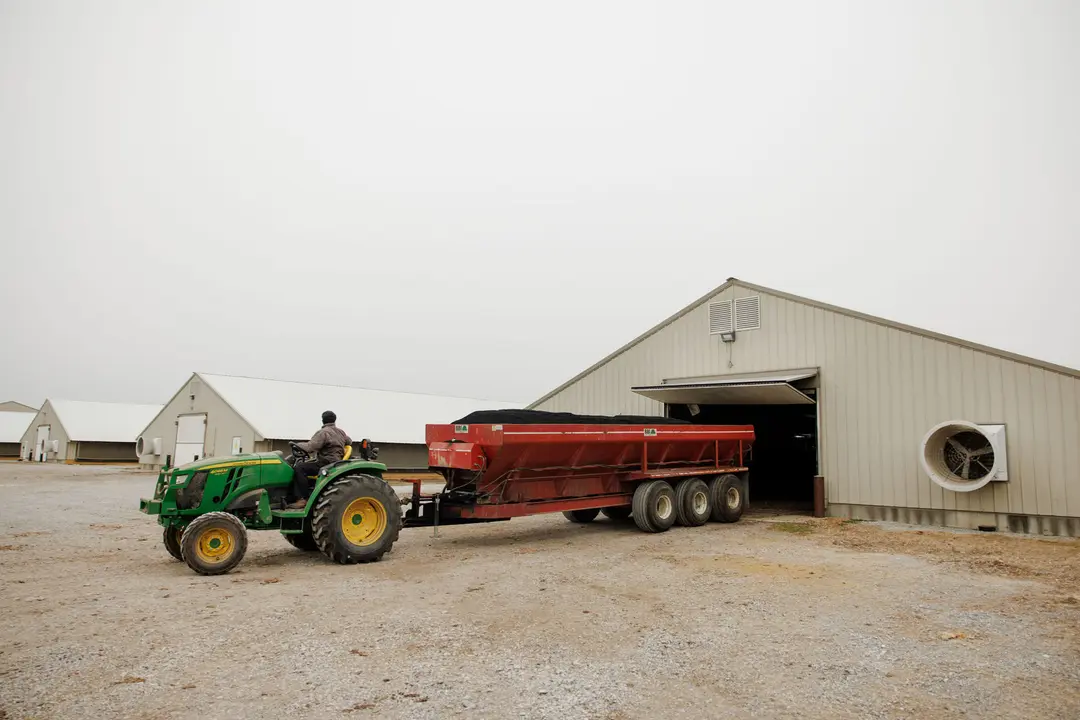
Valorize Systems is releasing AeroChar™, an acidified biochar for poultry litter that holds nitrogen in the litter as ammonium instead of losing it to the house as ammonia. It goes down before chick placement with the spreading equipment growers already run, and it holds roughly twice its weight in water. Unlike amendments consumed as they react, the carbon persists in the litter across flocks.
Ammonia, moisture, litter value, and nutrient loss are one problem, not four. Most treatments address one part of it.
What Is AeroChar?
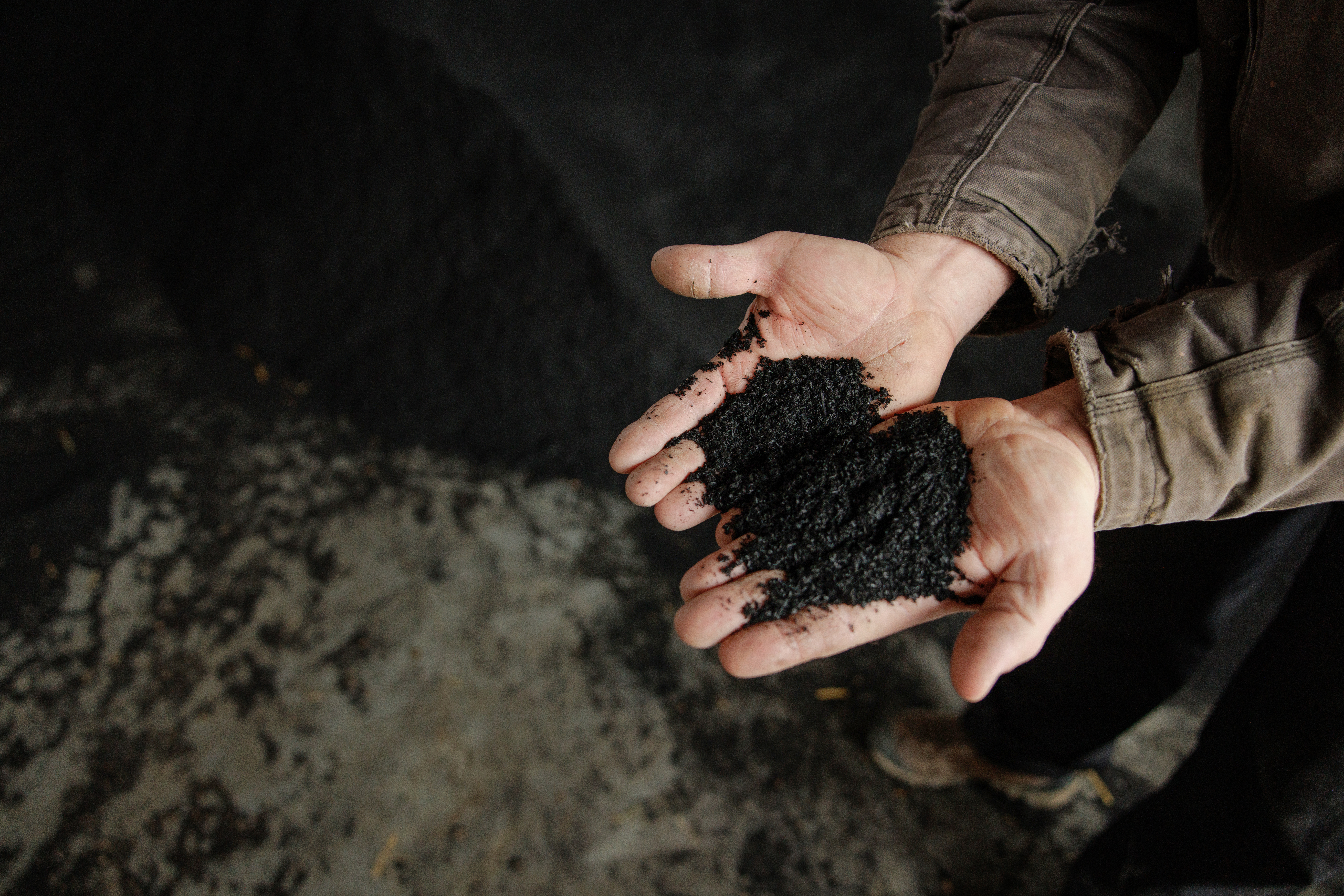
AeroChar is an engineered poultry litter amendment made from qualified biochar that Valorize acidifies with a food-grade organic acid, grades to a controlled particle size, and verifies against a finished-product specification before it ships.
The choice of acid does more than lower pH. The organic acid leaves behind an anion with documented antimicrobial activity, from the same class of compound used as a processing aid throughout poultry production. The material holds ammonium on the char's exchange sites while making the litter surface less hospitable to the microbial activity that generates ammonia in the first place.
Does Biochar Reduce Ammonia in a Poultry House?
It depends on pH and on when you look.
Raw biochar can reduce ammonia over the course of a flock. A 40-day incubation study found unmodified biochar cut cumulative ammonia emissions by 41 to 46 percent at its highest rates (Poudel et al., 2024). The problem is the front end. Most raw biochar is alkaline, and above a certain litter pH the equilibrium shifts from nonvolatile ammonium toward free ammonia. Adding an alkaline material at placement can push ammonia up exactly when chicks are least able to tolerate it and when early house conditions set up the rest of the grow-out.
Cumulative numbers hide that. A 42-day broiler study found unmodified biochar produced the lowest litter moisture of any treatment tested and the highest ammonia concentration (Mohammadi-Aragh et al., 2025). Moisture absorption is not ammonia control.
Acidification removes the tradeoff. A 21-day University of Georgia incubation study found acidified biochars reduced ammonia loss from poultry litter by 58 to 63 percent surface-applied and 56 to 60 percent incorporated, attributed to lower pH, hydrogen buffering capacity, and ammonium retention on the char's exchange sites (Doydora et al., 2011). That study applied treated litter to soil rather than running a live house, so it is not a flock-performance claim. It is a clean demonstration of why acidification matters.
No one has published a commercial paired-house trial of acidified biochar. That is what Valorize is running this fall.
Why Consistency Matters as Much as Chemistry
Biochar properties move with feedstock, reactor, and run conditions, so two loads from the same supplier can behave differently in the same house. Acid type matters too: a 2024 study of engineered miscanthus biochar found both production temperature and acid type significantly affected ammonia control performance (Chen et al., 2024).
AeroChar draws from a single facility producing more than 18,000 tons a year and holds the finished material to a tight spec. Every load ships with a certificate of analysis on the finished product, not the incoming raw char, covering pH, moisture, bulk density, particle-size distribution, fixed carbon, ash, feedstock, and batch. A full independent laboratory panel including trace metals is available on request.
AeroChar vs. Sodium Bisulfate
Sodium bisulfate and similar acidifiers are proven tools for pulling litter pH down early in a flock. AeroChar starts from different architecture: the acidity sits inside a porous carbon matrix that also manages moisture and is not consumed in the first weeks of a flock.
| Consideration | Sodium bisulfate and similar acidifiers | AeroChar |
|---|---|---|
| Primary mechanism | Topical mineral acid consumed as it reacts | Organic acid held in a porous carbon matrix |
| Moisture management | No meaningful water-holding capacity | Holds roughly 2x its weight in water |
| Microbial activity | Acidity only | Acidity plus an antimicrobial residual |
| Persistence | Consumed as it reacts | Carbon persists across flocks |
| Material at cleanout | Adds sodium and sulfate salts | Adds no sodium or sulfate |
| Application | Applied at placement, often reapplied mid-flock | Full rate at placement, reduced rate on subsequent flocks |
| Cost | Established program cost | Priced against your current PLT program |
Acidic amendments carry a known association with footpad damage, the standard objection to any acidified product. Holding the acidity inside a carbon matrix rather than as free acid on the litter surface is the design answer, and paw scoring is a named endpoint in every trial protocol.
Application Rate and Handling
The initial rate is 75 to 125 pounds per 1,000 square feet at placement, or about one ton for a 20,000 square foot house. Because carbon from the previous flock remains in the litter, subsequent flocks are topped up at a reduced rate rather than reapplied in full. The exact rate is set in the trial protocol against house conditions. Plan for a program across flocks, not a single application.
Because AeroChar uses a food-grade organic acid rather than a mineral acid, it handles more gently than the acidifiers most crews already work with. Standard PPE applies: gloves, eye protection, dust mask. The material is charcoal-black, goes down before chicks, and runs through conventional litter and drop spreaders. No new equipment, no separate workflow.
AeroChar is a litter treatment, not a feed additive, and it is not formulated for ingestion. It complements ventilation, water-line management, and integrator-approved practice rather than replacing any of it.
Trials: September Placements
Valorize writes the protocol, ships the material, and pairs treated houses against your current program so the result gets measured instead of argued.
Trials begin with September placements and participating complexes are being locked now. Growers and live-production teams across the Poultry Belt are already on the list.
Join the AeroChar waitlist and request a trial, and tell us your house count, current litter program, and target placement date.
Frequently Asked Questions About Biochar for Poultry
Is AeroChar the same as raw biochar?
No. AeroChar starts from qualified raw biochar, then Valorize acidifies it, controls particle size, and verifies each finished load against a specification. Raw biochar is usually alkaline, which works against ammonia control when it matters most.
What acid is used to make AeroChar?
A food-grade organic acid of the same class used as a processing aid in poultry production. Valorize does not publish the specific formulation, but every load ships with a certificate of analysis and a full independent laboratory panel is available on request.
What does AeroChar cost compared to PLT?
AeroChar is priced against your existing PLT program, with volume tiers from trial quantities through 1,000-ton supply. Contact us with house count and flock schedule for a rate.
Does acidified biochar cause footpad lesions?
It is a fair question for any acidified product. AeroChar holds its acidity inside a porous carbon matrix rather than as free acid on the litter surface, and that same matrix pulls moisture out of the litter, which is the primary driver of footpad quality. Paw scoring is scored against your current program in every trial. The material is black and can transfer visually to feathering early in a flock, which is tracked alongside paw scores.
Is AeroChar approved for organic production?
[CONFIRM: current OMRI or certifier status under the organic acid formulation, and what a grower should ask their certifier.]
Does AeroChar affect litter value at cleanout?
It is designed to help. Nitrogen retained as ammonium through the flock stays in the litter rather than volatilizing. Unlike salt-based acidifiers, AeroChar adds no sodium or sulfate to what you land-apply or sell. How much carbon remains at full cleanout is one of the things trials are measuring.
Can AeroChar be used in broiler and layer houses?
Yes, with a protocol matched to the housing system. Broiler trials are furthest along. Layer and pullet houses differ in litter depth, manure handling, and cleanout schedule, so rate and top-up interval are set per operation.