Biochar for Poultry: Meet AeroChar
AeroChar™ is a pH-modified poultry litter treatment. Apply 75–125 lb per 1,000 sq ft to retain nutrients and reduce ammonia and runoff.
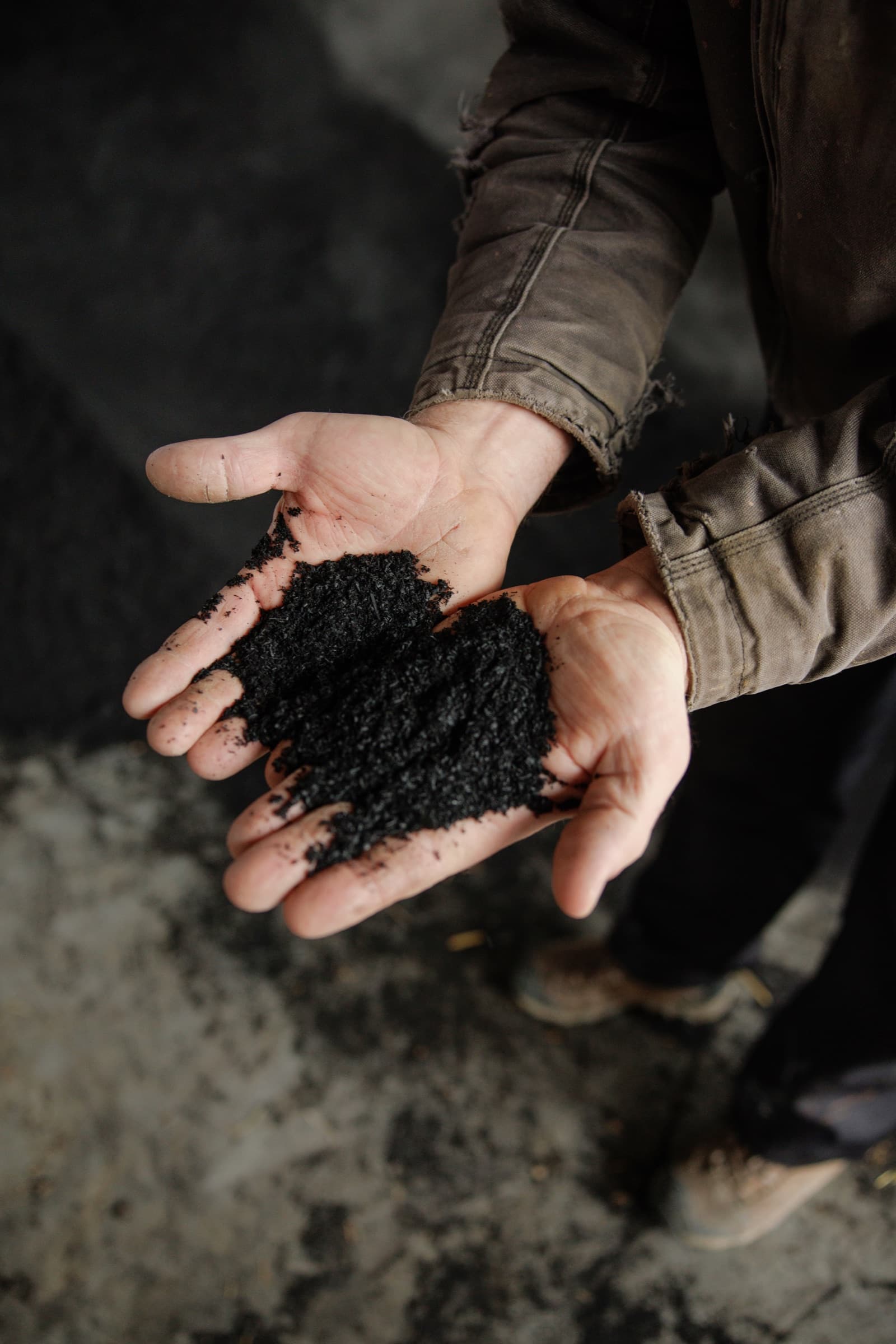 Real photo from our partners at BioSource
How Does AeroChar Compare With Sodium Bisulfate?
This table compares mechanism, application guidance, moisture behavior, and cleanout composition. It is not a published head-to-head AeroChar product trial; full-flock duration remains under evaluation.
| Property | Sodium bisulfate | AeroChar |
|---|---|---|
| Duration | 2 to 4 weeks, reapplied mid-flock | One application at placement, full-flock duration in trial |
| Mechanism | Topical acid, spent as it reacts | Acid held in a porous carbon matrix |
| Moisture | None, litter can cake | Holds about 2x its weight in water |
| At Cleanout | Adds sodium and sulfate salt | Nitrogen and phosphorus retained, plus stable carbon |
Beyond Ammonia
Ammonia Is Not the Only Thing That Changes
Lower ammonia is the first benefit you notice. It also leads to drier litter, more nutrients retained in the cake at cleanout, and less phosphorus leaving the field.
Birds
Paw Quality
Paw scores follow litter moisture, and the char holds about twice its weight in water. Drier litter through the grow-out is the lever, and for anyone selling paws into export markets it is the one that carries the most value.
Litter
N-P-K at Cleanout
Nitrogen that never leaves as ammonia is still in the cake when you clean out, along with the phosphorus and the stable carbon we added. The litter you spread or sell is worth more than litter that has gassed off half its nitrogen.
Watershed
Less Phosphorus Runoff
Phosphorus held in the litter is phosphorus that is not leaving the field. When the litter is land-applied, the same porous carbon slows dissolved phosphorus loss through adsorption and higher infiltration. On the shore, where nutrient runoff is the permit risk rather than a line on a budget, that is the number that matters.
Per-bird margin went from 38¢ to 98¢ across four groups. Darkling beetles are gone, ammonia is low enough to run minimum ventilation, and bird health is noticeably better.
Applying It
AeroChar is a fine, charcoal-black material applied to the litter before placement. It works with the spreader you already use, so no new equipment or changes to the crew’s routine are required.
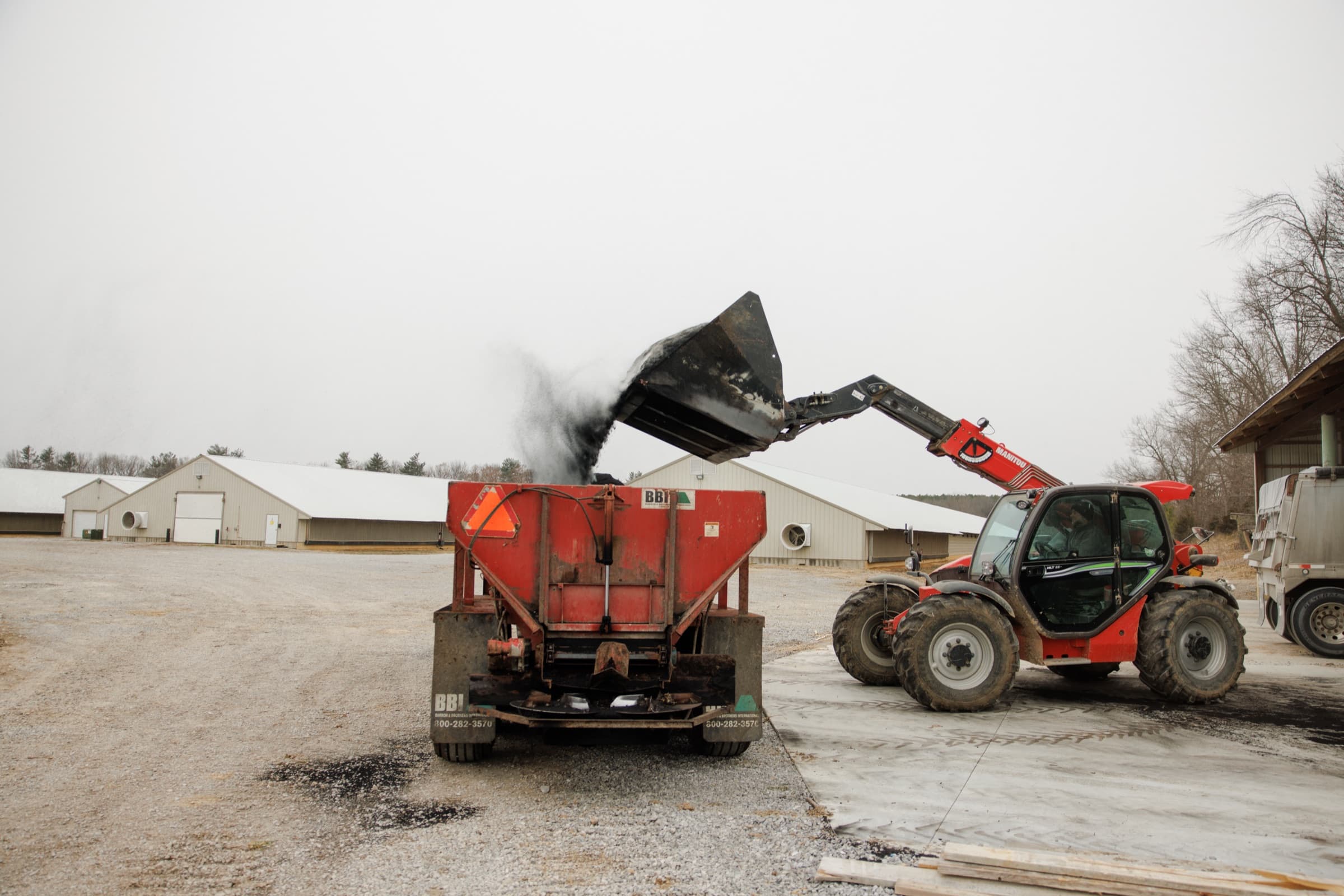 Real photo from our partners at BioSource
Material Specification
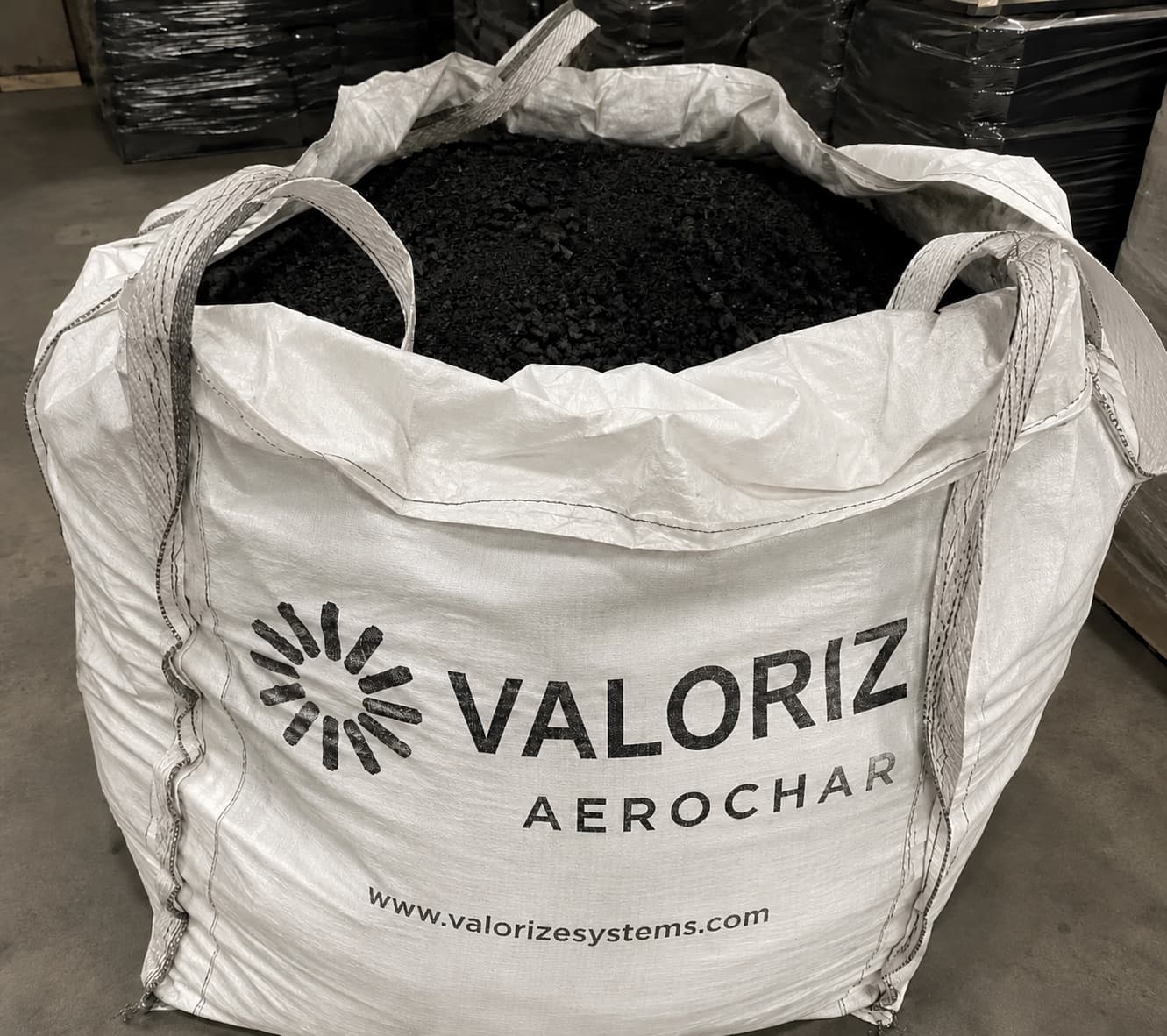
Every load ships with a certificate of analysis run on the finished material, not the incoming char: pH, moisture, bulk density, particle size distribution, fixed carbon, ash, feedstock and batch.
The full independent panel, including trace metals, is available on request.
Research
Raw Biochar vs Acidified Biochar
University of Georgia · Doydora et al.
Acidified biochar cut ammonia volatilization from poultry litter by 58 to 63% surface-applied and 56 to 60% incorporated, with no adverse effect on litter nitrogen or phosphorus availability. Un-acidified, higher-pH char did not deliver the reduction. Acidifying the char is the active step.
Doydora, Cabrera, Das, Gaskin, Sonon & Miller. Int. J. Environ. Res. Public Health 8(5):1491–1502 (2011).Auburn · Poudel et al.
In a 40-day incubation, biochar cut cumulative ammonia 41 to 46% while sodium bisulfate cut 91 to 100%. A static beaker test with no birds captures neither moisture nor longevity, which is where the acidified char earns its difference over a full flock.
Poudel, Chakraborty & Prasad. Poultry Science 103:104467 (2024).Mississippi State · Mohammadi-Aragh et al.
Over a 42-day flock, un-acidified biochar produced the lowest litter moisture of any treatment but the highest ammonia. Litter treatment had no effect on bird performance, so the amendments did no harm. The moisture benefit is real, and the high ammonia from plain char is exactly why we acidify.
Mohammadi-Aragh et al. J. Appl. Poult. Res. 34:100499 (2025).
Start With a Trial
Valorize writes the protocol, ships the material, and pairs the houses against what you run now, so the comparison is measured rather than argued.
Biochar for Poultry: Frequently Asked Questions
Raw biochar can be alkaline and variable. Acidified biochar lowers the material’s pH so more ammonium remains in its nonvolatile form. AeroChar also uses a defined finished-material specification for pH, moisture, particle size, carbon, ash, feedstock, and batch.
AeroChar is designed around the ammonia-retention mechanism reported for acidified biochar. The cited studies support that category mechanism, but a commercial AeroChar result should be evaluated through a paired-house trial with a written baseline, application rate, measurement method, and success threshold.
AeroChar is spread onto litter at placement using compatible material-handling equipment. The appropriate rate and any later application depend on the house, litter condition, current treatment, and approved trial protocol.